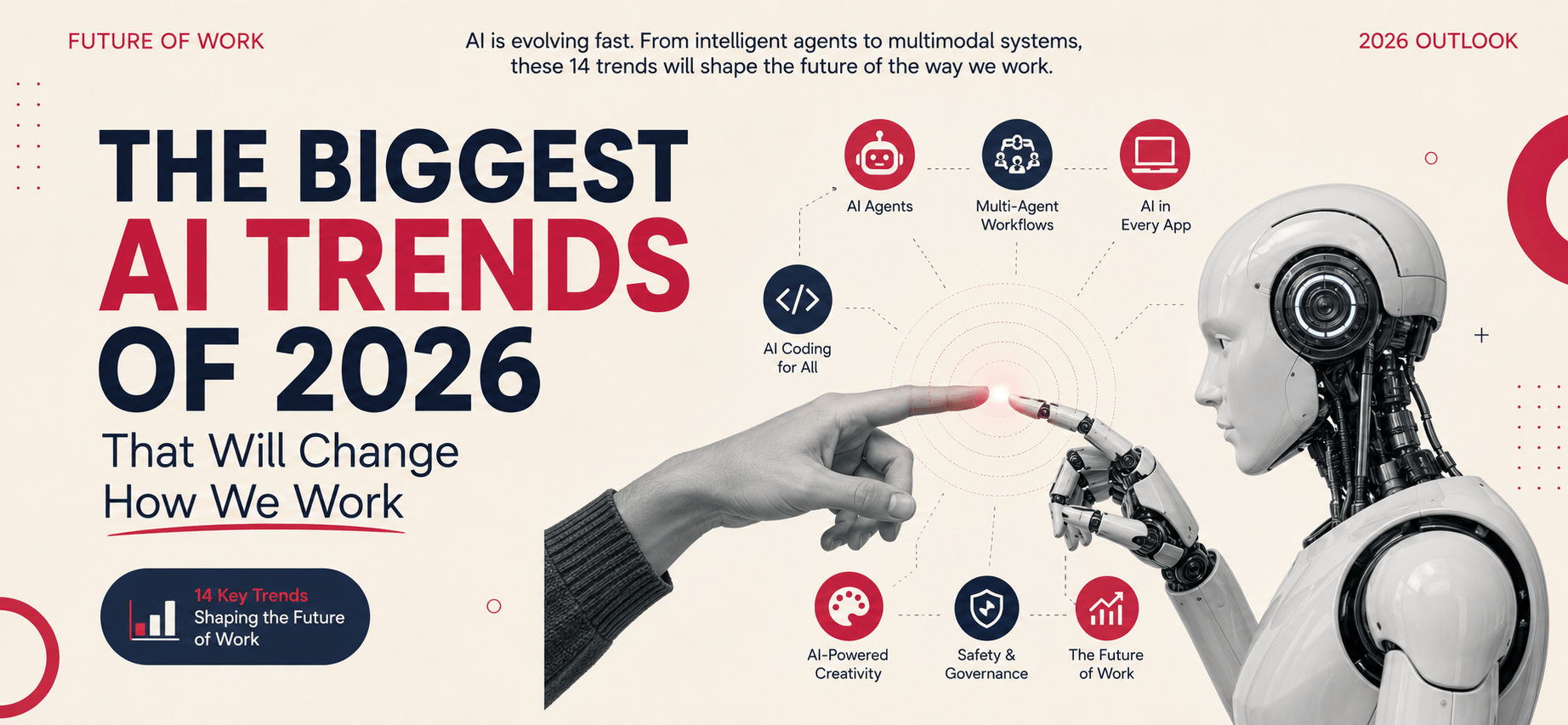
For designers, developers, marketers, founders, and everyday professionals, this means the way we work is changing quickly.
Microsoft's 2026 Work Trend Index describes a shift toward humans directing work while AI agents handle more of the execution. Its research also found that 58% of surveyed AI users say AI now helps them produce work they couldn't have produced a year earlier.
Here are 8 AI trends shaping work in 2026 and what they mean for you.
The biggest AI trend of 2026 is the rise of AI agents.
Traditional AI waits for you to ask a question and then gives you an answer. Agents are designed to take a goal, plan the steps, use tools, and complete parts of the task themselves.
For example, instead of asking AI:
"Write a marketing report."
You could ask an agent to:
This shift from answering questions to completing tasks is becoming one of the defining changes in workplace AI. OpenAI describes agentic AI as changing knowledge work from individual interactions toward delegated, longer-running tasks.
Google Cloud's 2026 research similarly expects agents to automate increasingly complex workflows and coordinate tasks across business functions.
What it means: Your future AI assistant may look less like a chatbot and more like a digital coworker.
One AI agent can be useful. Multiple specialized agents working together can be much more powerful.
Imagine a product launch handled by several AI agents:
Research Agent → Copywriting Agent → Design Agent → Developer Agent → QA Agent → Analytics Agent
Each agent handles a different part of the workflow.
This approach is already appearing in enterprise AI. Anthropic's research found that organizations are moving from simple automation toward multi-stage and cross-functional workflows, with 57% of surveyed organizations already deploying agents for multi-stage workflows.
What it means: Instead of learning dozens of AI tools individually, people may increasingly manage systems of AI tools.
Another major shift is computer-use AI.
AI systems are becoming better at interacting with software interfaces, websites, files, and other digital environments.
Instead of simply telling you how to complete a task, an AI agent can increasingly perform the task itself.
For example:
Old workflow:
AI explains how to create a spreadsheet → You open Excel → You enter the information → You format it.
New workflow:
AI understands the request → Opens the relevant tools → Creates the spreadsheet → Formats it → Gives you the result.
This is especially important because most knowledge work happens inside software.
What it means: The interface between humans and software may increasingly become natural language.
AI coding is no longer only for professional programmers.
Tools such as Cursor, Claude, ChatGPT and other AI development environments can generate, explain, debug, refactor, and test code.
In Anthropic's 2026 enterprise research, nearly 90% of surveyed organizations said they use AI to assist with development, while 86% reported deploying agents for production code.
And the trend is expanding beyond developers.
Designers can use AI to create prototypes. Marketers can build landing pages. Founders can create internal tools. Small businesses can automate workflows without hiring a large development team.
What it means: Knowing how to describe a technical problem may become almost as important as knowing how to write the code yourself.
.png)
AI is no longer limited to text.
Modern models can increasingly work with:
This creates much more natural workflows.
A designer could upload a screenshot and ask AI to analyze the hierarchy.
A developer could provide a screen recording of a bug.
A marketer could upload a PDF report and ask AI to create a presentation.
A researcher could provide documents, charts, and images together.
What it means: AI will understand more of the same inputs humans already use every day.
One of the biggest limitations of early AI assistants was that they didn't know enough about your actual work.
That is changing.
AI tools are increasingly being connected to:
Instead of asking:
"Write a project update."
You could eventually say:
"Prepare this week's project update based on our latest meetings, tasks, design changes, and development progress."
The AI has the context required to produce something useful.
What it means: The value of AI will increasingly depend on the quality of the context and data it can safely access.
AI assistants are evolving from generic tools into more personalized systems.
Instead of using the same assistant for everything, your AI could learn your preferred:
This could make AI much more useful for repetitive professional tasks.
For example:
"Prepare my weekly client update."
The system could already know the client's project, recent changes, outstanding tasks, and your preferred writing style.
What it means: The best AI assistant may not necessarily be the smartest model. It may be the one that understands your workflow best.
For decades, productivity largely meant doing more tasks in less time.
AI is challenging that definition.
If an AI agent can complete 50 repetitive tasks automatically, the valuable skill becomes deciding which tasks should be done in the first place.
Microsoft's 2026 research highlights this shift toward human agency. As agents take on more execution, people increasingly focus on setting direction, defining quality standards, making decisions, and evaluating outcomes.
This means skills such as these become more valuable:
What it means: Being busy won't necessarily mean being productive.
2026 is shaping up to be the year AI moves from something we use to something we work with.
Chatbots will continue to improve, but the bigger story is happening around them.
AI agents are taking on multi-step tasks. AI is becoming multimodal and context-aware. Coding is becoming more accessible. Creative tools are becoming more powerful. Search is becoming conversational. And businesses are beginning to redesign workflows around AI rather than simply adding AI tools to existing processes.
The people who benefit most won't necessarily be the ones who know the most AI terminology.
They'll be the people who understand what AI should do, what humans should do, and how the two can work together effectively.
And that may be the most important AI trend of 2026.

Get in touch to personalise your website with custom features and enhanced functionality.

250+ components. Zero fluff. Just clean webflow elements to help you build better websites faster.